
 by
by What if the most dangerous part of a DeFi transaction is not the final click, but the moment before it—when a familiar-looking screen hides what the smart contract will actually do? That question is more useful than asking whether one wallet is simply “safe.” A wallet is an interface, a key-management system, and a risk filter at the same time. Its value depends on how well those functions work together and how carefully the user interprets them.
For German-speaking DeFi users moving between Ethereum, layer-2 networks, sidechains, and newer EVM-compatible ecosystems, Rabby is designed around this problem. It positions itself as an alternative to MetaMask with a strong focus on multi-chain navigation, transaction simulation, and warnings before approval. The practical appeal is clear: fewer manual network changes and more information before signing. The important limitation is equally clear: no wallet can make an unsafe protocol, a compromised device, or a deceptive user interface harmless.
A realistic DeFi case: one user, three networks, several risks
Consider a user in Germany who holds ETH on Ethereum, stablecoins on Arbitrum, and a token on Base. They want to supply funds to a lending protocol, swap part of the position, and bridge assets when liquidity is cheaper on another chain. With a conventional workflow, the user must identify the correct network, verify the dApp domain, inspect token approvals, estimate fees, and understand the outcome of several contract calls. The risk is not only losing a private key. It is also signing the wrong action while believing it is routine.
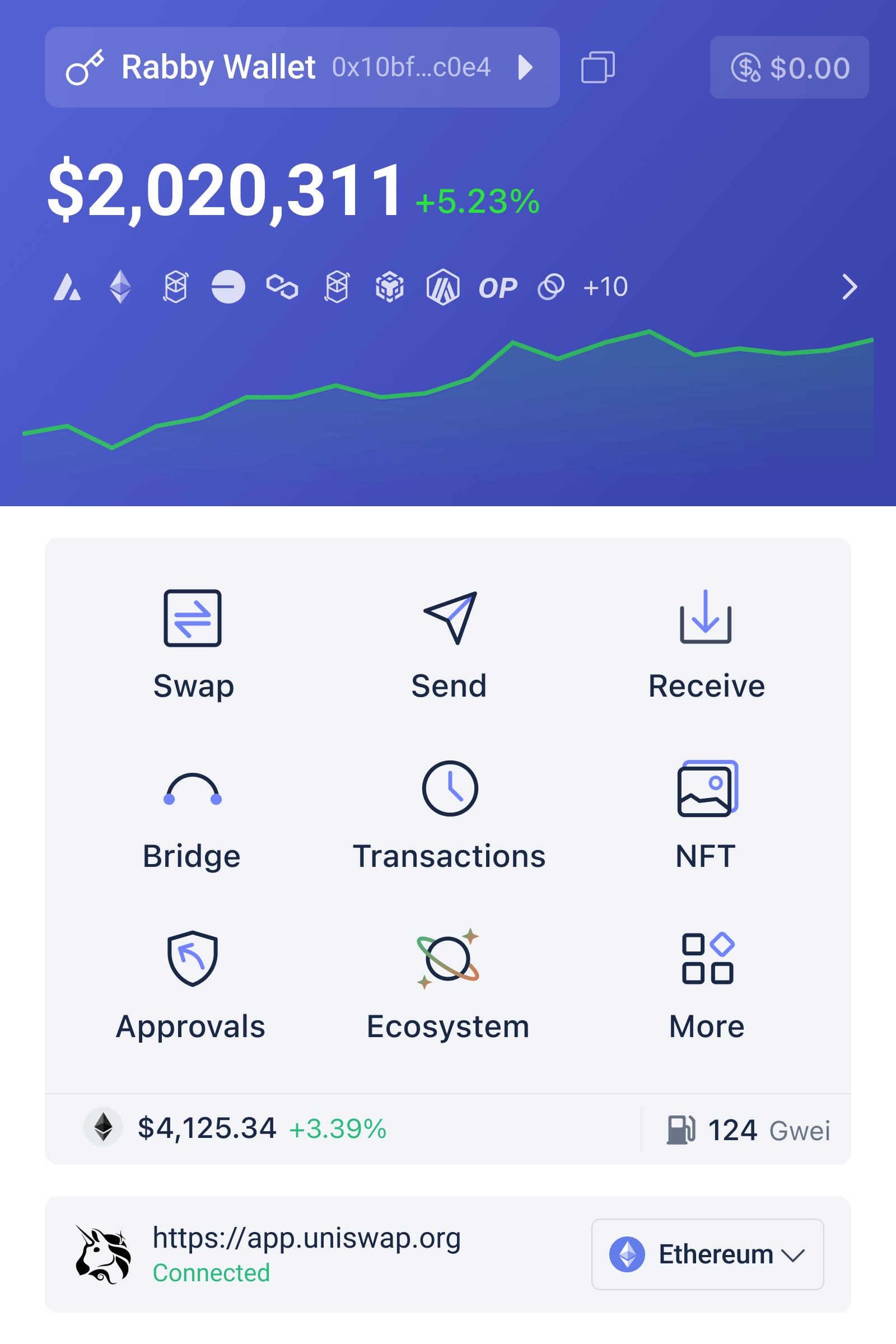
Rabby addresses part of this operational burden by detecting the network requested by a connected dApp and switching to it automatically. It supports more than 140 EVM-compatible networks, including Ethereum, Polygon, Arbitrum, Optimism, Avalanche, Base, and BNB Chain. That breadth is useful because EVM compatibility allows many applications to use related technical standards across chains. Yet compatibility does not mean that the networks have identical security, liquidity, fee markets, or bridge risk. Automatic switching reduces friction; it does not remove the need to check where an asset is held and which contract is being called.
This is why installation should be treated as a security procedure rather than a quick download. Users should obtain the extension or application from an official source, check the publisher and requested permissions, and create or import a wallet only in an environment they control. A recovery phrase should never be entered into a website, support chat, or unsolicited form. For readers comparing setup paths, the rabby wallet extension can be a practical starting point, but the link itself should not replace verification of the software’s provenance.
Transaction simulation changes the question from “Should I sign?” to “What will happen?”
The most important conceptual feature is transaction simulation. Before a signature is submitted, Rabby simulates the proposed action and presents expected changes to token balances. In simple terms, it tries to show the economic result of the contract call: which assets may leave the wallet, which may arrive, and whether an approval or other permission is involved.
That matters because a blockchain signature is not a general confirmation of a friendly intention. It authorizes a specific transaction encoded for a particular contract and network. A user may think they are claiming rewards while the transaction actually grants a broad token allowance. They may expect a swap while interacting with a malicious or altered contract. Simulation creates a second layer between the dApp’s wording and the user’s cryptographic authorization.
The non-obvious insight is that simulation is most valuable as a discrepancy detector, not as a guarantee. If the dApp says “deposit 100 USDC” but the wallet displays an unexpected token transfer, a large approval, or an unfamiliar recipient, the mismatch is a reason to stop. If the simulation looks normal, the transaction may still be dangerous in ways the model cannot fully capture. A malicious contract can behave differently under certain conditions, a protocol may carry economic risk after the transaction succeeds, and a compromised browser or device can undermine the entire review process.
Rabby’s integrated security engine adds warnings related to phishing, known exploits, suspicious addresses, and potentially unlimited token approvals. These signals are useful because many DeFi losses arise from repeated small decisions made under time pressure. But scanners depend on available information and detection logic. A new scam may not yet be recognized, and the absence of a warning is not equivalent to a security certification. Experienced users should read warnings, investigate the contract, and consider whether an approval can be limited or revoked later.
Non-custodial does not mean risk-free
Rabby is non-custodial: private keys are stored locally on the user’s device rather than transmitted to Rabby’s servers. This changes the trust model. The user does not hand control of funds to a central exchange or wallet operator, but assumes responsibility for the recovery phrase, device security, backups, and signing decisions. In practice, self-custody replaces one category of counterparty risk with a broader set of operational risks.
The wallet’s independence from its backend is also important, but it needs precise interpretation. Rabby does not create or alter the user’s transactions, and core signing functions can remain available if Rabby’s servers experience an outage. That separation can reduce dependence on a remote service for the act of authorization. It does not mean that every interface feature works without external infrastructure, nor does it protect against a malicious dApp, a stolen recovery phrase, malware, or a user approving the wrong contract.
For larger balances, hardware-wallet compatibility with Ledger, Trezor, and OneKey provides a stronger boundary around the private key. The transaction may still be prepared and explained in the browser, while the final signature is produced on a separate device. This improves key isolation, but it does not make the approval decision automatic. A user can still confirm a harmful transaction on a hardware device if the address, amount, network, or contract interaction is not checked carefully.
Convenience features: useful infrastructure with new trade-offs
Rabby also brings bridges, swaps, and fee management into the wallet interface. Its bridge integrations, including LI.FI, can help users move assets across networks without opening several separate applications. The swap aggregator can compare routes involving decentralized exchanges such as Uniswap and 1inch, with the aim of finding competitive pricing and limiting slippage. These functions reduce context switching, which is itself a security benefit: fewer copied addresses and fewer unfamiliar browser tabs can mean fewer opportunities for phishing.
However, aggregation does not eliminate market or protocol risk. A better displayed exchange rate may come with route complexity, liquidity constraints, bridge exposure, or contract interactions that the user would not encounter in a simple spot swap. Slippage is only one variable. Users should also examine the final received amount, the route, the approval requested, and whether the asset is being moved to a network they actually intend to use.
The Gas Account feature extends convenience further by allowing network fees to be paid with stablecoins such as USDC, even when the wallet lacks the native token required by that chain. This solves a common practical problem: funds can be present on a network while the user is unable to transact because they have no ETH, MATIC, or other native gas asset. The trade-off is that fee abstraction may hide an important operational detail. Users should still understand which network is paying the fee, what conversion or service mechanism is involved, and whether the balance is sufficient for later actions.
Rabby Points, earned through activities such as swaps, gas top-ups, or referrals, may make the product more engaging. But reward mechanics can also encourage unnecessary activity. A sensible rule is to treat points as incidental, never as a reason to increase transaction frequency, accept unfamiliar permissions, or take bridge and smart-contract risks that would otherwise be rejected.
How to install and use Rabby with a risk-management mindset
For a first setup, begin with a clean browser profile or a trusted device, install the official extension for a supported browser such as Chrome, Brave, or Edge, and verify that the wallet behaves as expected before transferring meaningful funds. Desktop versions for Windows and macOS, along with mobile applications for iOS and Android, broaden access, but each additional device becomes another environment that must be secured.
After setup, separate activities by risk. A small “hot” wallet can be used for experimentation, claims, and new protocols, while long-term holdings can remain behind a hardware wallet or in a separate account. Before every signature, check five elements: the network, the contract or recipient, the assets leaving, the assets expected in return, and the permission being granted. If any one of these is unclear, postpone the transaction. This checklist is more reusable than relying on a wallet brand’s reputation.
Open-source software, released under the MIT licence, enables community inspection and is a meaningful transparency feature. It should nevertheless be understood as a condition for review, not proof that every release is defect-free or that the installed package has not been tampered with. Security is layered: audited or inspectable code, local key storage, hardware isolation, simulation, warning systems, careful browser hygiene, and disciplined user decisions each address different failure modes.
What to watch as multi-chain wallets evolve
Recent Rabby messaging presents the wallet as a broad Ethereum and EVM gateway, emphasizing simplicity, speed, and security across chains. The direction is understandable. As users interact with more networks, the main usability problem shifts from learning one wallet to maintaining an accurate mental model of many execution environments. The likely test for products in this category will be whether automation can reduce mistakes without making users less attentive.
If simulation becomes more informative and warnings become better at explaining uncertainty, wallets could function less like passive key holders and more like transaction review systems. The conditional scenario is important: that benefit depends on accurate chain data, robust simulations, clear explanations, and users who treat alerts as evidence to evaluate rather than buttons to dismiss. In parallel, bridge integrations, stablecoin fee payment, and automatic network selection may increase adoption—but they may also concentrate more actions inside one interface, making interface integrity and permission design increasingly consequential.
Frequently asked questions
Is Rabby safer than MetaMask?
It is better described as a security- and multi-chain-focused alternative rather than an automatically safer replacement. Rabby offers transaction simulation, security warnings, broad EVM support, and hardware-wallet integration. Those features can improve decision quality, but the final risk still depends on the dApp, the device, the private-key practices, and the user’s interpretation of the information shown.
Can transaction simulation prevent every scam?
No. Simulation can reveal expected balance changes, approvals, and other discrepancies before signing, making it a valuable warning layer. It cannot guarantee that a protocol is economically sound, detect every new malicious contract, or protect a device whose recovery phrase or signing environment has been compromised. Treat a clean simulation as one positive signal, not as a final safety certificate.
Should I use Rabby for all my crypto holdings?
That depends on your custody preferences and risk profile. A practical approach is to keep limited funds in a browser wallet for active DeFi use and protect long-term holdings with a separate account or compatible hardware wallet. Diversifying operational exposure can reduce the damage from one compromised device, dApp approval, or mistaken signature.
The strongest reason to install Rabby is not that it removes DeFi risk. It is that it can make hidden transaction consequences more visible before a private key authorizes them. Used with separate accounts, hardware protection where appropriate, and a deliberate review habit, the browser wallet becomes a useful control point. The final security boundary, however, remains the user’s willingness to pause when the transaction does not make sense.
